 The first thing I see when I get off the marshrutka in Bandza, droghebi (cows). I knew I was home...
Due to power outages and a busy schedule (start of school, birthday, pregnant cow), I wasn’t able to really tackle my Tbilisi trip in the way I wanted, plus I have some thoughts churning up that do not involve Tbilisi, so I’ll try to sum up the leftovers on the capital in these next ten points. The lesson is to never let things sit, although I’m sure it won’t be the last time I make it to Tbilisi while over here.
Tertmet’i – Across from Old Tbilisi and up the slope of the hill, there’s quite the gentrification going on. It actually starts in Old Tbilisi, where the pedestrian walkway area leads to a brand new pedestrian bridge that crosses over the river. They still haven’t finished the entire bridge as it’s quartered off from the other side that leads to a yet-to-be finished park, but what is done is quite the spectacle. The entire bridge is made up of glass, and at night it’s glowing with lights that are built into the glass. More amazingly, the lights operate only when someone is on the bridge. The closer you get to the rail, the brighter that part of the bridge gets. For a country that is full of people living on the poverty line, it’s quite the lavish expenditure. Which isn’t to say that it’s not money well spent; it’s a really nice pedestrian bridge and is gorgeous at night silhouetting off the river. But I’m just sayin’…
 Nicest pedestrian bridge this side of Venice
Tormet’i - Probably an even worse offense is the Presidential Palace (pictured below), which, granted I know little about (like if it was built by Saakashvili or the previous president), sits atop the hill above the new pedestrian bridge and is an absolute monstrosity. The best way to describe it is if someone with zero class won the lottery and decided to build a house that they considered “real nice.” It’s got these ridiculous columns on the face of it (which looks over the center of the city) and then an even more ridiculous glass dome at the top. It looks like something out of a bad future sci-fi movie (think Starship Troopers, inter-galactic congress type of building). I know the Georgian people and politicians want to have a nice building where they can host foreign dignitaries, but I could think of a million better ways of going about it.
 That does not belong...
Tsamet’i – Like not building it in the middle of a slum. I mentioned earlier how Tbilisi, despite it being a fairly 21st-century city, is still full of shack-like homes and rundown housing. One day, we walked up towards the Presidential Palace and after being told not to take pictures of the foreign embassies (a fair request), we came up to the Palace, which was heavily guarded but not that far off the street. Right across was a house that looked like it was one crow’s nest away from falling down. This wasn’t exactly Pennsylvania Avenue to say the least. Not that there’s anything wrong with that, but if it tells us anything, it’s that the government tore down tons of those types of tenements just to build the Palace in the first place. Who knows what will happen to the remaining slums, but I don’t foresee a happy ending. There was already someone building a fairly posh looking residence up the street; all that needed to open were a yoga studio and an artesian bread shop and you have Williamsburg, Brooklyn all over again (and they didn’t even have the spur of a Presidential Palace; just a few white people with a superiority complex).
 That's more like it...
Totkhmet’i – Right up the street from the palace is the fairly new Georgian Orthodox Church and headquarters (it’s only ten years old). Now this makes sense. The church isn’t absurdly large (in fact, none of the Georgian Orthodox churches are big, something I’ll tackle at a different date), but sits in the middle of a gated and well-tended property. It’s tastefully done and well put together, the type of project that should have been emulated when thinking about a residence for the country’s most powerful person. I digress, but in a country filled with beautiful old buildings dotting the countryside, it’s weird that they could get it right with a church, but so wrong with a government building. Well, maybe it’s not that weird.
Tkhutmet’i – I said I’d get back to the Metro but there’s not much to say. It’s extremely easy to follow with just one main line (and another that we never used that makes it’s way up into the nicer suburbs south of the city) while also very affordable at just 40 tetri (24 cents) per ride. It’s a much easier way to get around than by bus or marshrutka. Unfortunately, I have no crazy stories about a man that refused to give up his seat. One thing that did stand out were the beggars on the Metro and how much business they received (business in terms of money, not business in my terms). Everybody gave them change, except for us volunteers. We have zero patience for Gypsy beggars.
 Public art in honor of the Rose Revolution inside the Metro
Teqvsmet’i – Bill was the most vehemently disgusted with Gypsies. One ruined his water by sticking their finger in the spout after being denied one of Bill’s new pears, while two other gypsies latched onto him for no apparent reason and gave him a “Gypsy Rash” on his arm that has yet to go away. Then while we were playing chess in the park, a little girl who was swimming in the fountain came over to us and started yapping at me in Georgian. I tried to communicate to her that I didn’t understand, and finally she got fed up and wandered off. Bill thought she wanted money and when I asked why, he said she was a Gypsy. “How did you know?” I asked. “She had dirty feet,” Bill replied. I hadn’t noticed, but apparently that’s a dead-giveaway. I have much to learn.
 These aren't Gypsies, but the couple who sang Georgian folk songs at the cafe I wrote about in the last post; couldn't leave them out
Chvidmet’i – Probably my favorite part about Tbilisi were the public parks. Having grown up in Pittsburgh and lived in Charleston, SC for a few years, I really appreciate a good public space, weather it’s a park, pedestrian walkway, or just a small fountain at an intersection (like Savannah, which has awesome public spaces). Tbilisi has heaps of parks and fountains that make the city both extremely livable and enjoyable. My favorite park ran down from Rustaveli Avenue to the river and a bridge that held a daily out-door bazaar. Being in Bandza makes me miss just walking to a park, sitting on a bench, and people watching (or as some like to call it, stalking).
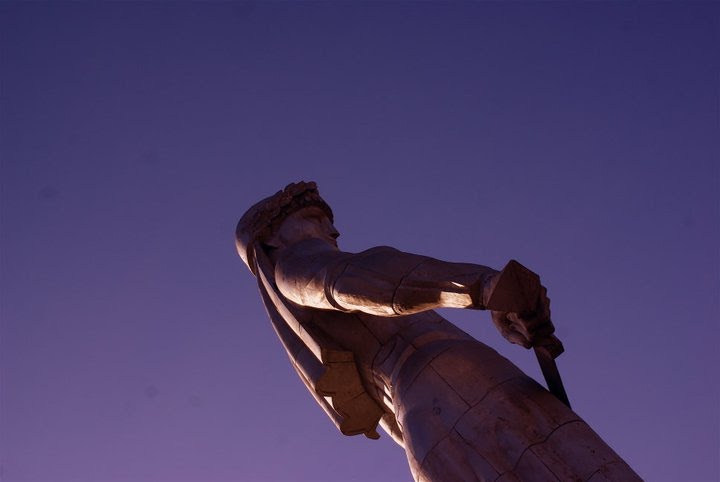
 Me looking up to the statue that stands in the front of my favorite park in Tbilisi
Trvamet’i – Tbilisi has everything, even it’s own Sea! Well, actually it’s a reservoir, but it’s called the Tbilisi Sea. A few of us went up there one of the days (missing the wedding in the process; bad friends we are) and got to see a fairly odd courting session. As I’ve mentioned, sexual relations in this country are highly suppressed and complicated. But the pressure put on women to remain chaste has one resounding effect: some of the men go insane after a certain point, and will do anything just for the scent of a woman (there’s a whole other post in here about how Georgian men treat and act towards foreign [specifically American] women). At the reservoir, this Georgian guy, probably about my age, hops in the water, gets out, and then sits five feet away from a group of three girls; all of this being about ten feet away from us (meanwhile, his clothes are on the opposite side of where we are sitting, making it all the more weird). As he lies facedown on the beach, he hums/sings some Georgian song while slowly but surely edging closer and closer to the girls. Eventually he edges a part of his body onto one of the girls’ towels, which only causes them to get up and resituate. But there were zero communicative objections so the guy just continues to creep closer and closer. We were somewhat concerned, but when we caught the look of one of the girls, she just animated that he was harmless if not a bit crazy. The whole thing was odd; is this how men pick up girls in Georgia? All we knew was that if you tried that at Folly Beach, you would have the cops called on you for some mixture of harassment and assault. I’m not doing the whole situation justice, but it was one of the weirder interactions I’ve seen since getting here.
 Sketchy Georgian creeping on some unsuspecting ladies at the Tbilisi Sea
Tskhramet’i – One of the last days while in Tbilisi, a group of us went to the dabanas (Turkish Baths) and got a scrub and massage. The girls and guys each got our own personal rooms, which meant that Bill, Raughley (lives in Tbilisi and knows Russian, a good guy to have around), and German Paul (only one of our group who was stationed in Batumi; highly hilarious if only for his German accent and laid-back seriousness) all got naked and sat in our personal bath/sauna (which we only lasted about 15 minutes in before having to get out and cool off). Needless to say, we all know each a whole lot better now than we did a few weeks ago. Once you’ve hung out with a buddy naked for an hour in a foreign country, you’ve officially gone from friends to good friends… and there’s no going back either. Eventually, this old wrinkly guy comes in wearing some sort of Speedo bathing suit and lays us down on this marble slab while scrubbing off all our dead skin (both sides) for five minutes. Then he gives you a five-minute massage (or cleaning) with soap, after which you soak in the tub for another ten minutes. It was the best 40 Lari ($24) I’ve ever spent. I felt five years younger when I got out of there. Thank God I don’t live in Tbilisi, because I would go broke from frequenting the baths. If anybody comes to visit, straight from the airport we’re going to take a shvitz (that’s actually a Yiddish word for sweat that my friends know me to use for shower).
 Paul, Bill, and Raughley moments after our scrub down and massage, looking like a million bucs
Otsi – Bonnie M. How did it take me so long to get back to their sweet, sweet sound. I’m sure no one really cares by this point (and if you did, you clicked on the link from the last post and read all you needed to know about this German Disco group made up of Caribbean dancers/singers). When we were in Zugdidi a while back, Bill kept on noticing the odd music that played on the marshrutkas; it was in English, but we had never heard it before. Who is this band that has all of these hits in Georgia (and if it’s a hit in Georgia, it’s probably a hit in Russia and the surrounding regions) but we’ve never heard of? The one song we kept hearing in particular had the refrain of, “Ra, Ra, Rasputin. Lover of the Russian Queen.” Before we even had to Google it, the Bonie M. DVD came on outside that café in Old Tbilisi and played Ra, Ra, Rasputin along with other hits such as Daddy Cool and Rivers of Babylon. We were both stunned and in awe of their musical genius. What topped it all off was at the beginning of every song, German Paul saying, “Yeah, I know this song, too.” F’n Germans.
 As promised, a picture of me with the crazy guy outside of the Beatles Club


 City Hall at Freedom Square
 Bill's and my apartment building, quite the palace
 The Catwalk from Hell; or it's literal translation in Georgian, Place of Rape.
 Ministry of Justice, say what? Little shout out for my Moms
 Bill in front of his bar; I've traveled 4000 miles to a small country in Eurasia, now where's the Goddamn saloon?
 I didn't really know where to splice these pictures in, but I figured the Synagogue would fit between the creepy Georgian men and the only gay bar in Georgia.
  This is a street that resembles Old Tbilisi (although I don't think it's actually in that neighborhood), but it's cobbled, narrow and snakes it's way up the hillside
 View from the balcony of our apartment in Didube, Tbilisi
 Jennifer's family's compound in Senaki
 I go from Death Camps to the cutest little girl in Senaki. Jennifer's host niece who is shown here dancing to Lady Gaga
 Bill ready to pass out in his sleeping spot on the train
 Bill next to the largest TV in Georgia, at least that's what we believe.
 Train Station in Tbilisi